


 For 59 minutes and 10 seconds, we saw what was building up to be the perfect Super Bowl. This was a game built up by a narrative that ran deep into the roots of NFL history, and it’s something that we spent a whole week analyzing. This was also a game that lived up to the narrative with two teams truly playing at a championship level. Then, we saw two coaching decisions unbecoming of the respective team’s excellence. The more fateful decision of the two provided for the most anti-climatic ending — and the first ever true “choke” job — in Super Bowl history. It cost us what would’ve been the perfect Super Bowl, regardless of who came out on top.
As we recap the Seahawks’ side of this epic battle, we’ll show how the game lived up to Seattle’s narrative until the final play. We’ll then break down why the decision to run a quick slant on second down from the one-yard line was the worst play-calling decision in NFL championship history and show how that decision cost us the perfect Super Bowl.

Richard Sherman’s reaction to the Seattle game-ending interception perfectly sums up the shock we as a football nation felt to close Super Bowl XLIX. (photo rights to NBC)
Seahawks Recap: Costing Us the Perfect Super Bowl
For the Seahawks, it seemed like Super Bowl XLIX was going to end up as expected for them despite an unusual path taken within the game. During parts of the game, it seemed like the Seahawks were being outmatched in ways we here at TABMathletics weren’t really expecting. New England seemed to perfect exploit the successful offensive gameplan used by the San Diego Chargers back in a Week 2 game that the Chargers defeated the Seahawks by a 30-21 score. Both teams used the short passing game to find open receivers and slowly move the chains. Meanwhile, Seattle was forced into getting its pass offense going exclusively through the downfield attack. Still, the Seahawks gained the control with a 24-14 fourth quarter lead. Not until Tom Brady put together an epic comeback did the Seahawks lose the lead, but they were in perfect position to get the lead back. That was until head coach Pete Carroll and offensive coordinator Darrell Bevell made their coaching decision of their respective football lives. Let’s breakdown the good, the bad and very ugly.
Part 1: The Turning Point for the Seattle Seahawks
As you may recall, we discussed how the vast important of Seattle’s red zone defense during its eight-game winning streak helped this team to once again play at a championship level. Seattle went from allowing 5.62 points per red zone opportunity during a 6-4 start to allowing 3.93 points per red zone opportunity during an eight-game winning streak. Super Bowl XLIX provided a bit of both dynamics.
We saw the good in Seattle’s red zone defense during its second drive of the game. New England saw success with the short passing, moving the ball 58 yards on 12 plays. This included two successful third down conversion. However, the Seahawks finally stiffened on defense on a 3rd-and-6 at the 10-yard line. Defensive lineman Michael Bennett got nice pressure on the stunt, forcing an errant pass by Tom Brady into the waiting hands of nickelback Jeremy Lane. The interception was Seattle’s lone stop in the red zone, and it ended being a costly one. Lane suffered a graphic injury — a broken arm — and it took the Seahawks a while to adjust.
It also opened up the door for the 10-point fourth quarter comeback, which marks the bad in Seattle’s red zone defense. Credit New England, who exploited replacement Tharold Simon quite extensively in this game. It was a weak point that the Patriots used go away from the already hobbled Legion of Boom. Imagine this: Earl Thomas has a separated shoulder, Richard Sherman has a torn elbow that reportedly needs Tommy John surgery, Kam Chancellor has a torn MCL (upated 2/4) and now Jeremy Lane is out with a compound fracture in his left arm. It was a tall task for this unit to hold up against Tom Brady, and the team just couldn’t hold up any longer in its final two drives of meaning. New England scored two consecutive red zone touchdowns, both of which relied on short passing. Ironically the play that started it all was a 21-yard completion to Julian Edelman. It was one of only deep passes completed by Brady, with the first being a touchdown pass to Rob Gronkowski that eerily resembled a Philadelphia Eagles touchdown on Seattle in Week 14.
If Seattle makes one red zone stop in those final two drives, the game is tied 24-24 heading into that final drive. We’re looking at the Seahawks settling for a game-winning field goal as time expired. That will be the part that makes the Legion of Bloom sleepless in Seattle for a long time. The injuries got the best of this team, and a quarterback like Tom Brady is just too good not to exploit it.
Part 2: The Excellence of Russell Wilson
We’re going a bit out of order, saving the Seahawks’ playoff emergence for last. Before we breakdown that fateful final play, we want to talk about Wilson was lining himself up to emerge as a truly elite quarterback. As we already mentioned in our Super Bowl XLIX preview, Wilson’s passing efficiency resonates through all relevant subsets. He continued that narrative on Sunday.
We saw the good for much of the game. Wilson finished with 12-of-21 passing for 247 yards, two touchdowns and one interception, good for a 110.62 passer rating that included a game-ending interception. Just to note, if the boneheaded play works, Wilson finishes with a 142.46 rating that would’ve ranked fourth all-time in Super Bowl history. That would given Wilson two of the top 10 passer rating performances in the big game. Instead, he settles for a strong game that was propped up by his successful down-field passing. According to Pro Football Reference, Wilson had a majority of his success on plays charted as “deep” passes. Check out the dynamic:
- Deep passing: 6-of-12 for 201 yards, no touchdowns and no interceptions (95.83 rating)
- Short passing: 6-of-8 for 46 yards, two touchdowns and one interception (88.54 rating)
Wilson achieved this despite his most effective receiver being an undrafted receiver from 2011 who never had an NFL catch until the Super Bowl. Chris Matthews had a breakout performance for the ages, but the usual tricks from Wilson allowed this union to blossom when Seattle needed it the most. Settling the score once again, Wilson proved his worth with a great performance under tough circumstances. To update Wilson’s subset passing statistics, we see how he’s still a quarterback a step away from being elite:
- Overall (42-14 record): 917-of-1454 for 11770 yards, 84 touchdowns and 31 interceptions (98.74 passer rating)
- Opp. Winning Teams (19-9 record): 464-of-764 for 6026 yards, 48 touchdowns and 13 interceptions (99.41 passer rating)
- Passing v. Top 12 DPR (17-7 record): 382-of-634 for 5052 yards, 37 touchdowns and 16 interceptions (94.43 passer rating)
- Games with 24+ PA (2-9 record): 207-of-332 for 2517 yards, 18 touchdowns and seven interceptions (94.92 passer rating)
If there’s any one quality we feel Wilson is missing when it comes to being an elite quarterback, it’s his lack of elite-level command of the game. This is something that honestly came to fruition during the game-ending play. Wilson seemed to defend the play call for a quick slant at the one-yard line, so he must learn that this isn’t proper game management. He needed to see how the space wasn’t available for the slant and to audible into another play. When he’s able to do something like that on a normal basis, he’ll be an elite quarterback.
Still, we consider the bad for Wilson is this game to be sheer luck. Despite a winning performance from both quarterbacks, one had to lose the game. It happened to be Wilson, who threw a good pass on the game’s final play, given the play call. If a different pass play is drawn up, we’re confident Wilson gets the go-ahead touchdown pass. Note that Wilson now owns a 2-9 record when Seattle allows 24+ points, but seven of those losses involves opponents getting a fourth-quarter comeback. That’s simply bad luck for Wilson.
Part 3: The Postseason Emergence of the Seattle Seahawks
Here’s where we start to see perfection ruined. As we discussed during our week-long Super Bowl preview, the 2011-14 Seahawks shared an eerie set of parallels to the 1990-93 Cowboys. As the game-deciding play of the game set up, it seemed like fate that Seattle would grab a 31-28 lead in the game’s final minute. If the Seahawks were to lose, it would come in overtime. However, the Legion of Boom would have their drive of redemption to try to stop Brady one final game and get the team back-to-back victories.
During the final drive, the good came from the odds. According to Pro Football Reference, the Seahawks’ odds of winning shot up from 34.0 percent to 84.9 percent after the miraculous 33-yard reception by Jermaine Kearse. Luck seemed to be on Seattle’s side, and our perfect ending to this game suddenly meant that Russell Wilson would convert on is comeback drive attempt. On Twitter, our own Adam Dobrowolski had three words (or players, to be more exact) to sum up the enormity of this catch.
Tyree. Manningham. Kearse.
— Adam D. Dobrowolski (@Adam_Dobber) February 2, 2015
Kearse got out of bounds with 1:06 left in the game. However, the game soon became unhinged for the Seahawks.
Thus enters the bad. After the dizzying madness and shock of the Kearse catch, the Seahawks will ill prepared to run another play. They were forced to call a second timeout with the clock stopped during this drive. With the odds suddenly favoring Seattle, it seemed like this timeout was nothing to note. However, what it did was give the Patriots a chance for the auto-win if they make the stop on this final defensive series. It came do-or-die for Seattle for unnecessary reasons. Pin this on poor game management.
The series began in beastly fashion, with Marshawn Lynch running the ball down to the one-yard line. However, the Patriots made a monster mistake in not calling a timeout after the run. We think the timeout should’ve been called with 59 second left, but Bill Belichick for some unknown reason decided to let the clock run. This was an open invitation for the Seahawks to score on the next play and take nearly 40 seconds off the clock. We’ll have more on that in two days. However, because the Seahawks only had one timeout left, it forced them into an unnecessary pickle. Seattle can only stop the clock after one of two plays before fourth down, meaning that they must make some game management decisions about having the simple safety blanket of stopping the clock whenever needed.
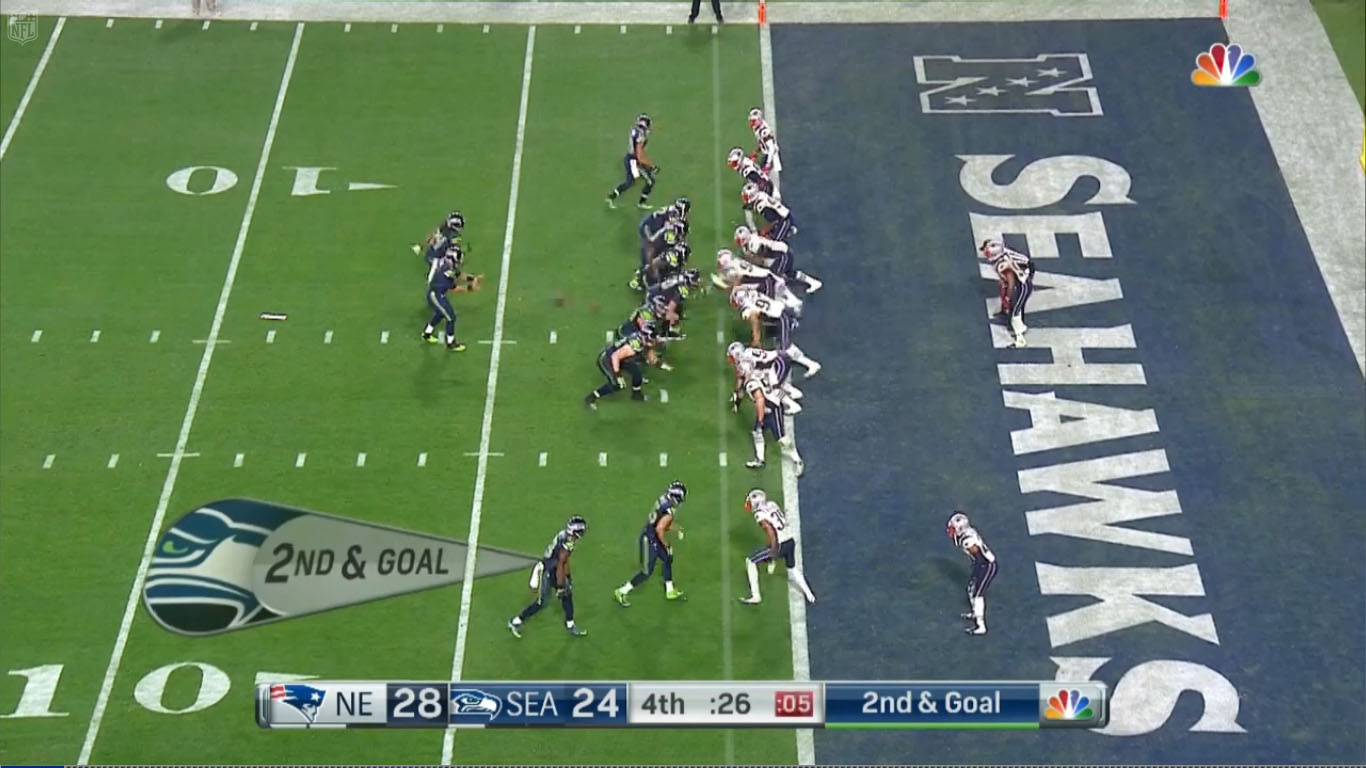
It led to Seattle’s demise, which brings us to the very ugly juncture on this game. After Lynch’s run to the one, it seemed obvious to attempt another run. However, with just one timeout left, the Seahawks honest were best suited setting up one pass play and one run play before a potential fourth down play. As the clock continues to run, Seattle comes out into a formation like this:
(photo rights to NBC)
First, it’s a great disservice to the offense to come out with a shotgun snap in an 11 formation at the one-yard line. This is a serious epidemic in the NFL, one which defies logic. Although the Patriots came out in a goal line defense, they were prepared for the pass. This formation is one tall tell sign that the pass is a likely possibility. Second, after Baldwin (top receiver) goes in motion, it leaves the two bottom receivers in a stacked formation in a slot position. This makes any inside pass destined to be forced through traffic.
AND YET…

(photo rights to NBC)
What happened are showed with the red arrow. Any possibility of what SHOULD’VE happened with that formation is in the blue arrow. Super Bowl hero Malcolm Butler made a bee-line for the spot that covers the inside slant, which shows an incredible recognition on his part. If Ricardo Lockette (83) is designed to make the double move, cutting outside after faking the slant, it’s a walk-in touchdown pass. Of course, Lockette keeps going, this play can be designed for the Wilson rollout. He gets the touchdown if Jermaine Kearse (15) holds the block on Browner, or if Wilson works some of his elusive magic. If neither seems feasible, there’s always a soft pass over the top to Marshawn Lynch (24). He might not be open, but if this was a “wasted play” like Pete Carroll claimed, an overthrow provides no harm.
What DOES provide harm is calling for the rhythm-based quick slant, one which requires Kearse to get a push on his block and requires Lockette to get the spot first. This play takes away the ability of Russell Wilson, which is who you want deciding this outcome if it’s not Marshawn Lynch. This was shaky situation to begin, given the formation, but this was the worst possible play to draw up in this formation.
Tomorrow, we will break out some alternate options for passing, given Seattle’s passing strengths and given the rest of the league’s handling of pass plays from the one-yard line in similar situations. For now, we want to imagine what would have been the perfect ending to this Super Bowl. We consider the surrounding narrative and the immediate context of the game.
- 1st-and-10, NWE 38 w/ 1:14 left: Wilson pass deep right compete to Kearse for 33 yards, out-of-bounds, FIRST DOWN
- 1st-and-G, NWE 5 w/ 1:06 left: Lynch rush left tackle for 4 yards
- 2nd-and-G, NWE 1 w/ 0:59 left: New England timeout, 2nd of the half
- 2nd-and-G, NWE 1 w/ 0:59 left: Wilson play-action pass short middle to Luke Willson for 1 yards, TOUCHDOWN
- Extra point w/ 0:53 left: Hauschka kick GOOD… Seattle 31, New England 28
- Kickoff w/ 0:53 left: Hauschka kickoff with no return for a touchback
- 1st-and-10, NWE 20 w/ 0:53 left: Brady begins New England drive
From a narrative and context standpoint, we find this to be perfect. If the Seahawks hold, it’s done after Russell Wilson put together one of the greatest touchdown drives in Super Bowl history. And they would get the job by exploiting New England’s weakest part defensively (30th in pass DVOA against tight ends, per Football Outsiders). And it would mention New England is 3-3 in the Super Bowl in the Belichick-Brady era with three epic catches to create those losses. If the Patriots tie the game, it completes Tom Brady’s performance of putting together the best fourth quarter of any quarterback in Super Bowl history. Plus, we would get our first overtime game.
Most importantly, the Seattle defensive stand or overtime finish would be a fitting end for two great franchises confirming their respective lot in NFL history. Both teams played an awesome game, but nothing a few mere moments of falling short. With this ending, we’d be talking about the two quarterbacks going back and forth in an epic finish, which is fitting one a soon-to-be elite quarterback facing one of the game’s greats. The defensive pass wouldn’t come into question, as both squads limited to their opponent to one zone of passing (short or deep). We’d be talking about Seattle’s clutch first half drive ended with a touchdown to end the half. The lone controversy would be Logan Ryan playing off coverage from breakout star Chris Matthews. We’d be talking about the best Super Bowl ever, and one that focuses on either Seattle becoming a potential dynasty in the making or New England signing the exclamation point to a true dynasty that can only be a rivaled by a few franchises. This could’ve been a landmark game in NFL history of all the correct reasons.
Instead, we’re left to focus on the most anti-climactic ending in NFL history. From Seattle’s perspective, this is the first true choke in Super Bowl history. This was not a botched 47-yard field goal to conclude the 1990 season, but a botched one-yard offensive play to conclude the 2014 season. The former was an understandable outcome. The latter was an inexcusable one.