


 For 59 minutes and 10 seconds, we saw what was building up to be the perfect Super Bowl. This was a game built up by a narrative that ran deep into the roots of NFL history, and it’s something that we spent a whole week analyzing. This was also a game that lived up to the narrative with two teams truly playing at a championship level. Then, we saw two coaching decisions unbecoming of the respective team’s excellence. The more fateful decision of the two provided for the most anti-climatic ending — and the first ever true “choke” job — in Super Bowl history. It cost us what would’ve been the perfect Super Bowl, regardless of who came out on top.
As we recap the Seahawks’ side of this epic battle, we’ll show how the game lived up to Seattle’s narrative until the final play. We’ll then break down why the decision to run a quick slant on second down from the one-yard line was the worst play-calling decision in NFL championship history and show how that decision cost us the perfect Super Bowl.

Richard Sherman’s reaction to the Seattle game-ending interception perfectly sums up the shock we as a football nation felt to close Super Bowl XLIX. (photo rights to NBC)
The Worst Play-calling Decision in NFL Championship History
This is quite the definite statement to make, but one we’re willing to back up. As we mentioned yesterday, it’s not to decision to pass that’s so inexcusable, but the decision to pass by using an inside quick slant from the one-yard line that’s so inexcusable. This is the year 2014 after all, and we’ve gotten so sophisticated with the passing game that the league averaged a 87.1 passer rating this season. A huge part of that reason is that the league collectively doesn’t get so sloppy with ball protection in the passing game any more. The league collectively threw only 450 interceptions on 17879 pass attempts, resulting in a paltry 2.52 interception percentage.
One huge reason for this uptick in efficiency involves how well passing offenses now use space. All offenses run plays rooted in the West Coast Offense, just like the Seahawks did when using the inside quick slant. However, the West Coast Offense plays work well when used in space. That offense broke out in the 1980’s, when defenses weren’t particularly used to short passes leading way to yards after the catch. When drawing up a play from the one-yard line, yards after the catch are primarily moot. Instead, it’s all about finding a way to get the ball to a receiver in open space, doing so to a place where no defender can possibly intercept the ball.
Seattle head coach Pete Carroll and offensive coordinator Darrell Bevell failed miserably at grasping that note, one which absolutely cannot be forgotten in crunch time of the Super Bowl. They put quarterback Russell Wilson into harm’s way of losing the game, as that route gave the Patriots one slight window to make a game-ending play on a second-and-goal play. Malcolm Butler and the Patriots made the most of it, teaching the Seahawks a lesson at the most critical juncture possible.
The truth is that no team since 1998 threw an interception at the one-yard line with a chance for the go-ahead score in the final two minutes of the game. In fact, there’s only been one other turnover in that situation during that 17-season span. This makes Seattle’s mistake arguably the worst mistake of the last 17 years, and it happened during the team’s most important game of the season. Honestly, a coaching staff can’t screw it up any worse than Carroll and Bevell did, which is why call it the worst play-calling decision in NFL championship history. Just look at every pass play in this situation with the offense down 4-6 points (per Pro Football Reference):
- 2000, Week 16 (Rams 35, Buccaneers 31): Buccaneers QB Shaun King pass incomplete on first down (rush TD next play)
- 2001, Week 5 (Panthers 25, Saints 20): Saints QB Aaron Brooks pass incomplete on first down (rush TD next play)
- 2001, Week 11 (Jaguars 21, Ravens 17): Ravens QB Elvis Grbac pass incomplete on first down (3-yd pass TD two plays later)
- 2002, Week 16 (Ravens 13, Browns 7): Browns QB Tim Couch TD pass on second down
- 2003, Week 13 (Patriots 38, Colts 34): Colts QB Peyton Manning pass incomplete on third down (run stop on next play)
- 2005, Week 13 (Bills 23, Dolphins 17): Dolphins QB Sage Rosenfels spiked pass on first down
- 2005, Week 13 (Bills 23, Dolphins 17): Rosenfels pass incomplete on second down (4-yd pass TD two plays later)
- 2005, Week 14 (Chiefs 28, Cowboys 24): Cowboys QB Drew Bledsoe TD pass on second down
- 2008, Week 10 (Cardinals 29, 49ers 24): 49ers QB Shaun Hill spiked pass on first down (run stop two plays later)
- 2009, Week 10 (Patriots 34, Colts 28): Colts QB Peyton Manning TD pass on second down
- 2009, Week 11 (Browns 37, Lions 31): Lions QB Matthew Stafford TD pass on untimed down (final play of game)
- 2010, Week 7 (Rams 17, Buccaneers 12): Buccaneers QB Josh Freeman pass incomplete on first down
- 2010, Week 7 (Rams 17, Buccaneers 12): Freeman TD pass on second down
- 2011, Week 11 (Browns 14, Jaguars 10): Jaguars QB Blaine Gabbert pass incomplete on second down
- 2011, Week 11 (Browns 14, Jaguars 10): Gabbert pass incomplete on third down (final play of game)
- 2011, Week 14 (Lions 34, Vikings 28): Vikings QB Joe Webb sacked and lost fumble on first down (final play of game)
- 2011, Week 16 (Texans 16, Colts 12): Colts QB Dan Orlovsky TD pass on first down
- 2012, Week 2 (Ravens 23, Eagles 17): Eagles QB Michael Vick pass incomplete on second down (rush TD next play)
- 2012, Week 10 (Saints 31, Falcons 27): Falcons QB Matt Ryan pass incomplete on second down (pass stop two plays later)
- 2012, Week 11 (Cowboys 17, Browns 13): Browns QB Brandon Weeden pass incomplete on fourth down
- 2012, Week 14 (Buccaneers 21, Eagles 16): Eagles QB Nick Foles spiked pass on first down
- 2012, Week 14 (Buccaneers 21, Eagles 16): Foles TD pass on second down (final play of game)
- 2013, Week 8 (Seahawks 14, Rams 9): Rams QB Kellen Clemens pass incomplete on fourth down (final play of game)
- 2013, Week 14 (Browns 26, Patriots 21): Patriots QB Tom Brady TD pass on first down
- 2014, Week 4 (49ers 26, Eagles 21): Eagles QB Nick Foles pass incomplete on third down
- 2014, Week 4 (49ers 26, Eagles 21): Foles pass incomplete on fourth down
- 2014, Week 13 (Ravens 33, Chargers 27): Chargers QB Philip Rivers TD pass on first down
- 2014, Week 14 (Browns 24, Colts 18): Colts QB Andrew Luck TD pass on first down
- Super Bowl XLIX (Patriots 28, Seahawks 24): Seahawks QB Russell Wilson pass intercepted on second down
Judge the list for yourself. Teams in this situation ran 26 pass plays since 1998, excluding the three spiked passes. They finish with a combined 10-of-25 passing and own a combined 15-8 record. Only two games ended with a turnover. One of those teams was the 3-13 Vikings with Joe Webb under center. Running back Adrian Peterson did not play in this game. The other happened in the Super Bowl, with an almost-elite Russell Wilson and a healthy Marshawn Lynch ready bowl over defenders for the lead.
These results say that the pass play isn’t the best option (38.46 percent success rate including the fumble lost). However, the run play actually isn’t much better of an option (42.55 percent success rate and 22-14 record) in the same subset. Note that there were no turnovers in the subset, though. The subset results suggest that choosing a pass play isn’t a bad option, but now we’ll break down the most recent pass successes to show where the Seahawks made their bone-headed mistake.
Andrew Luck pulls off an another epic comeback (2014, Week 14: Colts over Browns)
The Browns once had a 21-7 lead, but the offense fizzled out in the second half. That left the door open for one of several epic comebacks already on Andrew Luck’s ledger (and there will be more to come in the future). Down 24-19 with 3:46 left, Luck converted two key passes on third down to help drive the Colts down the Cleveland 3-yard line. Then Dan Herron converted a fourth down run to the 1-yd line play. It set up 1st-and-goal with 36 seconds left, and the Browns called timeout. The Colts drew up this play:

(photo rights to FOX)
Like the Seahawks, the Colts were trying to use a wide receiver for pick or rub. Reggie Wayne (87) does so out wide to the bottom of the screen, running towards slot receiver T.Y. Hilton (13). As the two receivers converge, it effectively wipes out both Browns cornerbacks. Luck then throws to Hilton as the receiver cuts left, doing so with a pass low and away so no interception is possible. It’s a wonderfully drawn play using the same personnel (11 in shotgun) that Seattle did on Sunday. Note that the Colts were facing six defenders at the line (compared to the Seahawks facing seven), but they had one of the league’s worst rushing attacks. All that becomes moot when you draw up a play that opens the entire left third of the end zone for your top receiver. Well done by Indianapolis.
Rivers to Royal: Where There’s Smoke, There’s Paydirt (2014, Week 13: Chargers over Ravens)
Another late and frantic comeback happened just a week earlier, and it also ended on a late go-ahead touchdown pass from the one-yard line. Down 30-20 with six minutes left to go, San Diego’s offensive margin for error was down to nothing. Philip Rivers ended up leading two consecutive touchdown drives to finish the game and earn the comeback victory. The first drive with a deep TD pass to Keenan Allen. The second drive nearly ended the same way to Eddie Royal, but a Baltimore defensive pass interference set up the ball at the 1-yd line. The Chargers decided to cue up Royal again on the very next play to grab the late one-point lead:

(photo rights to CBS)
Eddie Royal (11) runs a smoke route, with Keenan Allen (13) providing the block. Because the block is made within one yard of the line of scrimmage, it is a legal block by Allen. In the process, Allen takes his cornerback with him to open up the space for Royal. Meanwhile, Rivers throws a forward pass to be caught behind the line of scrimmage, so only Royal catches it as long as it doesn’t bounce off his hands. With a pass so short and soft, a pass bouncing off Royal’s hands and into Baltimore’s hands is extremely unlikely. Thus, the play is very safe. It’s also a very effective way to allow a small and quick receiver to do his thing. Also, we again see 11 personnel.
Brady Beats Browns with Epic Comeback (2013, Week 14: Patriots over Browns)
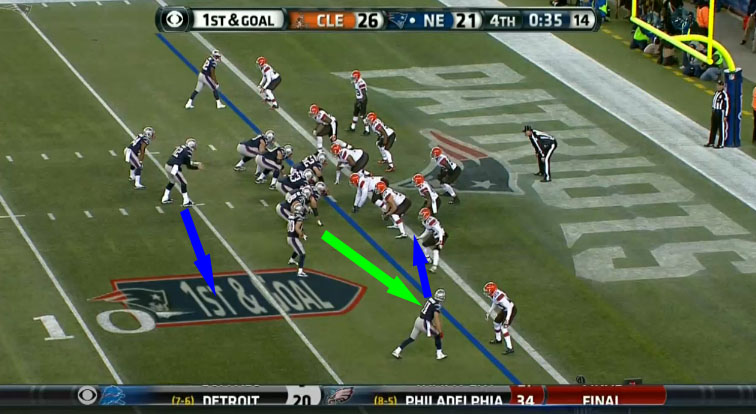
Maybe Cleveland should lobby for a bye in Week 14 next year. Again the Browns could a double-digit second half lead, only it’s 19-3 this time late in the third quarter. Already without Rob Gronkowski (who suffered his torn ACL in this game), the Patriots saw a masterful Tom Brady down the stretch. However, a comeback is only possible after recovering an onside kick and forcing a Cleveland DPI. That set up a New England pass play from the 1-yard line to grab a 27-26 lead. Check out the comeback and the go-ahead play:
(photo rights to CBS)
Hopefully, you’re starting to see the trend. The clear go-to personnel as of late is the 11 when passing from the 1-yard line. The two-receiver side has one block or rub to open up space, while the other is the intended receiver. Here, Julian Edelman (11) blocks for Danny Amendola (80), with a rollout by Tom Brady (12) helping to make a better angle for the pass. The Cleveland coverage is pretty good here, so the rollout is extremely helpful. Still, Brady throws a great pass to the front right corner of the end zone to hit Amendola.
The Beginning of Nick Foles (2012, Week 14: Eagles over Buccaneers)
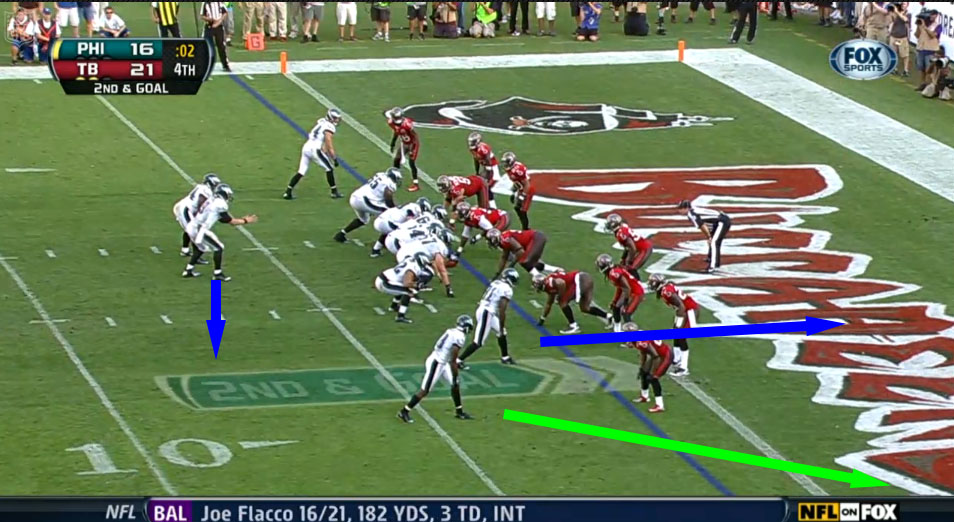
Ah yes, another Week 14 game. Philadelphia earned it’s lone victory over the final 12 games of the season, but only did so after overcoming an 11-point deficit in the final four minutes. Foles led his first fourth-quarter comeback in epic fashion, including hitting a deep pass up the middle to the two-yard line and spiking the ensuing pass with just two seconds left. Thus came an all-or-nothing play,which set up Foles’ first great moment under center. Check out the comeback and the game-winning play for the Eagles:
(photo rights to FOX)
Guess what? It’s another play with 11 personnel. It’s also another play with the pass intended on the two-receiver season. However, for the first time, we don’t see a receiver pick or rub or block. Instead, Foles rolls out to the right and hits Jeremy Maclin (18) on the right sideline. It’s funny, though, because we’d accept a forced pass here. After all, it’s the game’s final play, and the Eagles NEED a touchdown. Andy Reid isn’t known for handing goal-line situations well, but he draws up a play to give his rookie QB a chance to win.
Lessons Learned: The Personnel Works, but the Route Doesn’t
Any idea that simply passing the ball was wrong involves what NFL coaches would probably consider outdated thinking. Personally speaking, using the 11 personnel can be quite annoying when pounding the ball feels like a more feasible option. However, the personnel lends for some plays that can work.Seattle simply used the worst possible route for that personnel. The Seahawks had receivers in the personnel quite tight, much like the Eagles did in the 2012, but Seattle was actually on the left hash. Thus, the Seahawks had more room to design a route to get Ricardo Lockette or Jermaine Kearse towards the sideline.
We close with one more note: teams who ran a pass play on first or second down in this subset finished with a 13-2 record (excluding situations where time expired before the series could end). This means that teams with enough time generally draw up the game-winning play, whether or not the pass succeeded. Therefore, we agree with the decision to pass. We agree with the decision to use the 11 personnel. We even agree with the idea that the second pass can be a “wasted play” with the opponent coverage is strong. However, we DON’T and NEVER WILL agree with the inside quick slant. This was the only play that could end the game on second down.
Therefore, this is the worst play-calling decision in Super Bowl history and the first true choke in Super Bowl history.