
This Sunday, we will get to see four teams battle it out for the right to go to the Super Bowl. Only two teams can win, but the memories of these games could last a lifetime. In fact, my first truly vivid memories of a football fan came watching NFL conference championship games. Hearkening back to the days as a five-year-old, I recall the 1994 AFC Championship Game coming to a shocking end as Dennis Gibson batted down a Pittsburgh Steelers fourth down pass attempt to secure a 17-13 upset victory. I still recall loading up on the Pixy Stix as the game was on too. I also recall a much more painful (at least from my perspective) outcome in the NFC Championship Game, when the Dallas Cowboys saw their hopes of a three-peat come to an end, as the San Francisco 49ers won 38-28 at home.
Those were the days that got me to feel romantic about the NFL postseason, which eventually got me to feel romantic about the sport and the league in general. My feelings haven’t dwindled, as the following years saw many great moments in the conference championship games. Since the 1995 season, the classic moments of the conference championship games include:
- 1995 AFCCG: Harbaugh’s Near Miracle — the 9-7 Indianapolis Colts nearly win in Pittsburgh on a Hail Mary attempt
- 1998 NFCCG: Gary Anderson misses his first field goal of the season en route to the 15-1 Minnesota Vikings’ overtime loss
- 1999 NFCCG: Bert Emanuel’s no-catch sets up a receiving rule change (which was muddled by recent changes)
- 2002 NFCCG: Ronde Barber’s pick-six closes Veterans Stadium with a Philadelphia Eagles loss
- 2006 AFCCG: The Indianapolis Colts finally break through against the New England Patriots via an 18-point comeback
- 2007 NFCCG: Brett Favre throws a virtual game-ending interception in overtime to send the New York Giants to victory
- 2009 NFCCG: Favre strikes again with an interception that sends the Vikings to another overtime loss
- 2011 AFCCG: Billy Cundiff shanks a potential game-tying field goal to send the Patriots to another Super Bowl
- 2011 NFCCG: Kyle Williams calls the Cundiff ante with a fumble to send the Giants to another Super Bowl
- 2013 NFCCG: Richard Sherman’s tip clinches a Seattle Seahawks win and sets up an epic post-game jab
Clearly, the romance hasn’t died. Perhaps another great moment like this happens on Sunday.
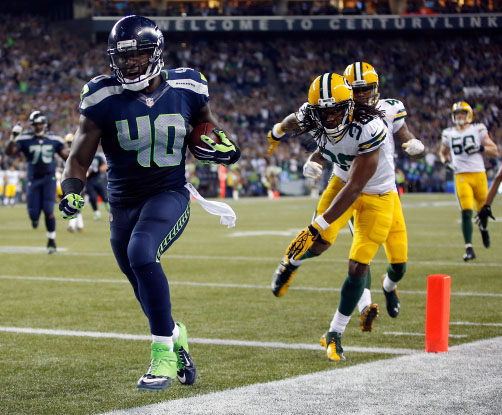
Derrick Coleman (40) seals a 36-16 Seattle Seahawks over the Green Bay Packers in Week 1. (photo rights to Otto Greule Jr / Getty Images)
However, the two match-ups at hand come after the respective home teams (on Sunday) won in the blowout fashion in the regular season. In the NFC Championship Game, the Seahawks host the Green Bay Packers in a rematch of a 36-16 victory in Week 1 at CenturyLink Field. In the AFC Championship Game, the Patriots host the Colts in a rematch of a 42-20 road win in Week 11. This marks only the third time in NFL history that both conference championship games feature a rematch of regular season games decided by 20+ points. In 1981, both home teams (Cincinnati Bengals and San Francisco 49ers) won in both the regular season and postseason. In 2007, the Patriots won their rematch at home, while the Packers… well, you already know.
Does that mean the Seahawks and Patriots are at a distinct precedent-based advantage? Here at TABMathletics, we don’t believe four games fit a proper sample size, so we decided to dig into deeper context. According to Pro Football Reference, there were 129 regular season games (from 1990 to 2013) between two playoff teams decided by 20+ points. Include 14 more such games from this season, and the 144-game sample size leaves us a well-supported means for discussion. Of those games, we already have 33 rematches in the postseason books, including two that featured each team previously winning by 20+ points. Those games can give us insight for the 34th and 35th installment of the “blowout rematch.”
Below, we have the details of the 33 playoff rematches in this subset. Included in the table are the “blowout” winners and the rematch outcomes, as well as the other regular season meetings for the intra-divisional match-ups. You may be surprised by the results.
Table 1: Blowout Rematches in the Postseason (since 1990)
| Game | Match-up | Blowout | Other | Rematch |
|---|---|---|---|---|
| 1990 WC | (A6) Oilers (9-7) at (A3) Bengals (9-7) | Bengals, 40-20 (home) Oilers, 48-17 (home) |
None | Bengals, 41-14 |
| 1990 Div | (A4) Dolphins (12-4) at (A1) Bills (13-3) | Dolphins, 30-7 (home) | Bills, 44-34 (home) | Bills, 44-34 |
| 1991 WC | (N6) Falcons (10-6) at (N3) Saints (11-5) | Saints, 27-6 (away) | Falcons, 23-20 OT (away) | Falcons, 27-20 |
| 1991 Div | (A4) Chiefs (10-6) at (A1) Bills (13-3) | Chiefs, 33-6 (home) | None | Bills, 37-14 |
| 1991 Div | (A3) Oilers (11-5) at (A2) Broncos (12-4) | Oilers, 42-14 (home) | None | Broncos, 26-24 |
| 1991 Div | (N6) Falcons (10-6) at (N1) Redskins (14-2) | Redskins, 56-17 (home) | None | Redskins, 24-7 |
| 1991 Div | (N5) Cowboys (11-5) at (N2) Lions (12-4) | Lions, 34-10 (home) | None | Lions, 38-6 |
| 1991 CC | (N2) Lions (12-4) at (N1) Redskins (14-2) | Redskins, 45-0 (home) | None | Redskins, 41-10 |
| 1992 WC | (A5) Oilers (10-6) at (A4) Bills (11-5) | Oilers, 27-3 (home) | None | Bills, 41-38 OT |
| 1992 Div | (N5) Eagles (11-5) at (N2) Cowboys (13-3) | Eagles, 31-7 (home) | Cowboys, 20-10 (home) | Cowboys, 34-10 |
| 1992 CC | (A4) Bills (11-5) at (A2) Dolphins (11-5) | Dolphins, 37-10 (away) | Bills, 26-20 (away) | Bills, 29-10 |
| 1993 Div | (A3) Chiefs (11-5) at (A2) Oilers (12-4) | Oilers, 30-0 (home) | None | Chiefs, 28-20 |
| 1993 Div | (N6) Packers (9-7) at (N1) Cowboys (12-4) | Cowboys, 36-14 (home) | None | Cowboys, 27-17 |
| 1994 WC | (N6) Bears (9-7) at (N3) Vikings (10-6) | Vikings, 42-14 (away) | Vikings, 33-27 OT (home) | Bears, 35-18 |
| SB XXIX | (A2) Chargers (11-5) v. (N1) 49ers (13-3) | 49ers, 38-15 (away) | None | 49ers, 49-26 |
| 1995 Div | (N4) Eagles (10-6) at (N1) Cowboys (12-4) | Cowboys, 34-12 (home) | Eagles, 20-17 (home) | Cowboys, 30-11 |
| 1998 WC | (N6) Cardinals (9-7) at (N3) Cowboys (10-6) | Cowboys, 38-10 (home) | Cowboys, 35-28 (away) | Cardinals, 20-7 |
| 1999 CC | (A4) Titans (13-3) at (A1) Jaguars (14-2) | Titans, 41-14 (home) | Titans, 20-19 (away) | Titans, 33-14 |
| 2002 CC | (A2) Titans (11-5) at (A1) Raiders (11-5) | Raiders, 52-25 (home) | None | Raiders, 41-24 |
| 2003 WC | (N5) Seahawks (10-6) at (N4) Packers (10-6) | Packers, 35-13 (home) | None | Packers, 33-27 OT |
| 2006 Div | (N4) Seahawks (9-7) at (N1) Bears (13-3) | Bears, 37-6 (home) | None | Bears, 27-24 OT |
| 2007 CC | (A3) Chargers (11-5) at (A1) Patriots (16-0) | Patriots, 38-14 (home) | None | Patriots, 21-12 |
| 2007 CC | (N5) Giants (10-6) at (N2) Packers (13-3) | Packers, 35-13 (away) | None | Giants, 23-20 OT |
| 2008 CC | (N6) Eagles (9-6-1) at (N4) Cardinals (9-7) | Eagles, 48-20 (home) | None | Cardinals, 32-25 |
| 2009 WC | (A5) Jets (9-7) at (A4) Bengals (10-6) | Jets, 37-0 (home) | None | Jets, 24-14 |
| 2009 WC | (N6) Eagles (11-5) at (N3) Cowboys (11-5) | Cowboys, 24-0 (home) | Cowboys, 20-16 (away) | Cowboys, 34-14 |
| 2009 WC | (N5) Packers (11-5) at (N4) Cardinals (10-6) | Packers, 33-7 (away) | None | Cardinals, 51-45 OT |
| 2010 Div | (A6) Jets (11-5) at (A1) Patriots (14-2) | Patriots, 45-3 (home) | Jets, 28-14 (home) | Jets, 28-21 |
| 2012 Div | (A3) Texans (12-4) at (A2) Patriots (12-4) | Patriots, 42-14 (home) | None | Patriots, 41-28 |
| 2013 Div | (N6) Saints (11-5) at (N1) Seahawks (13-3) | Seahawks, 34-7 (home) | None | Seahawks, 23-15 |
| 2013 CC | (N5) 49ers (12-4) at (N1) Seahawks (13-3) | Seahawks, 29-3 (home) | 49ers, 19-17 (home) | Seahawks, 23-17 |
| 2014 WC | (A6) Ravens (10-6) at (A3) Steelers (11-5) | Ravens, 26-6 (home) Steelers, 43-23 (home) |
None | Ravens, 30-17 |
| 2014 WC | (A5) Bengals (10-5-1) at (A4) Colts (11-5) | Colts, 27-0 (home) | None | Colts, 26-10 |
NOTE: We consider a “blowout” to be any outcome decided by 20+ points.
The table shows a mixed bags of outcomes in the postseason. Teams with the regular season victory of 20+ points own just a 19-16 record in the postseason rematch. This could very much speak to two things: (1) NFL teams are generally able to better scheme for the rematch after being beaten so bad in the initial meeting, and (2) playoff-level teams generally don’t play bad enough to lose by 20+ points, so the rematch features a “regression to the mean” of sorts. There is probably more to this record as well.
However, for the sake of Sunday, we want to put this study’s results into the context of (N2) Packers (12-4) at (N1) Seahawks (12-4) and (A4) Colts (11-5) at (A1) Patriots (12-4) in their respective match-ups. Note that both match-ups do not feature a intra-divisional battle, so we can exclude the 13 games that qualify for that subset. Thus, the record changes to 13-7 for the regular season “blowout” winners. Suddenly, it seems like there’s an advantage, which is actually quite notable at nearly 2:1. We can look deeper into related details now.
Home teams own a whopping 16-3 record in inter-divisional games, regardless on whether they won or lost the “blowout” game. Also, of the three winners, only one actually earned the blowout victory. That was the 2009 Jets during a Week 17 that saw three blowouts that set up three Wild Card rematches. We should note that 13 of 19 blowout winners earned the home game in the postseason rematch. Those teams went 11-2, with the one upset involving Joe Montana and the other involving the most unlikely Super Bowl team ever.
Of those 13 winners, only one team earned its regular season “blowout” victory on the road. Can you guess that team? It’s the 2007 Packers, who defeated the Giants 35-13 back in Week 2. Thus, precedent says if a team already earned the home blowout victory in the regular season, it will most likely take the home rematch in the postseason. These teams own a near-perfect 11-1 record in the postseason rematch. Here’s guessing Aaron Rodgers has to channel his inner Joe to win on Sunday.
As for the conference championship backdrop, we don’t have much of a sample size. There were eight previous conference championships that fit this criteria since 1990, three of which feature intra-divisional match-ups. The blowout winners went 2-1 in those games. As for the other five games, the blowout winners own a 3-2 record. We recap the five games:
- 1991: Redskins blowout Lions in Week 1 at home, Redskins blowout Lions in postseason rematch at home
- 2002: Raiders blowout Titans in Week 4 at home, Raiders win by 17 points in postseason rematch at home
- 2007: Patriots blowout Chargers in Week 2 at home, Patriots win by nine points in postseason rematch at home
- 2007: Packers blowout Giants in Week 2 on the road, Packers get Favre’d during postseason rematch at home
- 2008: Eagles blowout Cardinals in Week 13 at home, Eagles lose by seven points in the postseason rematch on the road
The conference championship backdrop seems to be nothing but a mere coincidence. The Seahawks-Packers match-up could remind you of the 1991 NFC Championship Game, being that a Week 1 blowout set up a postseason rematch between the NFC’s top two seeds. However, the Redskins-Lions games were far too one-sided. Also, the Lions were postseason green thumbs at that time, while these Packers made the postseason for the sixth consecutive season. The connection is merely circumstantial.
Our conclusion? The only strong correlation presented by this study involves the home team in a postseason rematch featuring teams from separate divisions. Perhaps it’s a case of familiarity — but not too much familiarity. There will be little to no surprises in a rematch, as both teams have fresh tape to digest. However, these teams aren’t so familiar to the point of feeling comfortable playing in opponent territory in a huge spot. Actually, I personally don’t believe in home-field advantage for intra-divisional games.
For the Seahawks-Packers match-up, we can note that the previous 12 teams with a home rematch of a home inter-divisional blowout saw their average margin of victory drop from 28.83 points per game to 12.83 points per game. It’s a considerable drop, but one that truly threatens Seattle in a normal situation. We saw two blowout wins (both in 1991), three one-possession wins and one loss for the home teams in those 12 games. Heck, the Seahawks themselves did this last year, beating the Saints by 24 at home in primetime and winning the rematch by eight points. Seattle controlled the game, leading for over 55 minutes and holding a multi-possession lead for over 33 of those minutes. This match-up truly favors the Seahawks, especially with Green Bay’s amber-flagged 4-4 road record.
For the Patriots-Colts match-up, we have literally the smallest possible sample size to work with to relate to this situation. One would and should consider a road blowout victory against a playoff team a better accomplishment than a home blowout victory against a playoff team. Yet somehow, the only team to cash in a rematch of that game with a home playoff game found a way to lose to most unlikely Super Bowl team ever. Thanks, Brett Favre and the 2007 Packers. We have nothing to go on as a comparative tool from this study. Instead, we’re going to look a bit outside the box. According to Pro Football Reference, there were 55 postseason games (from 1990 to 2013) decided by 20+ points. We saw seven rematches during the succeeding postseason, with the original blowout winners going 5-2 in those games. Albeit with limits of relevance and sample size, this match-up seems to favor the Patriots.